Householding process
The WebMD Ignite data mastering process takes patient data and consumer data, and when there’s a match for all 4 demographic fields required for mastering, the data is merged into a single record to create a 360° profile for every person aged 18+ and pediatric patients ages 0-17 in the application. With our proprietary householding process, we then go a step further by identifying and grouping those mastered individuals who live together in the same household.
When creating your target audience and communication strategy, householding helps you:
- Improve marketing efficiency: Reduce direct mail costs and streamline your message by limiting it to one piece per household, if desired. Think flu shot or primary care campaigns for the whole family.
- Acquire pediatric patients: By law, you can’t market directly to minors (ages 0-17), but for pediatric campaigns, you can communicate with the head of household (HoH) associated with minors in your target audience. The HoH is assigned during the householding process.
- Reach household decision makers: Create “on behalf of” messaging for those who influence the healthcare decisions and behaviors of others in the same household; for example, an adult female whose spouse qualifies for a heart screening.
How households are grouped
People are considered to be in the same household if they live at the same address and have similar last names.
Same address
We consider addresses to be the same if all these are true:
- The address has been certified as valid by a USPS validation service
- Complete street address (including box/unit/etc.) is the same
- First 5 digits of ZIP code are the same
Similar last names
We consider the last name to be the same if any of these are true:
- Last name is exactly the same, ignoring case
- For example (“VanZant” is considered exactly the same as “vanZant”)
- Last name is at least 5 characters long and is phonetically the same, as defined by English phonetic comparison algorithm, Soundex.
- For example (“Smith’ and “Smyth” are considered the same because both resolve to a Soundex value of S530)
After individuals are grouped into the same household, they all share a core set of attributes that define the household, including number of children and household income.
Example record processing
| Record | Same Address? | Similar Last Name? | Result |
|
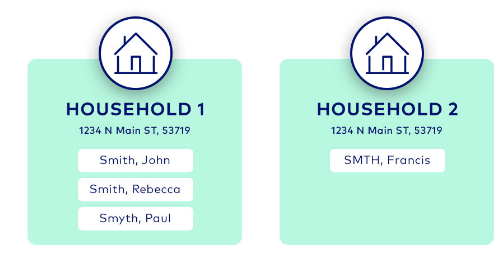
1234 N Main ST, 53719 - Smith, John
|
|||
| 1234 N Main ST, 53719 - Smith, Rebecca | Y | Y - Exact | Same Household |
| 1234 N Main ST, 53719 - Smyth, Paul | Y | Y - 5 characters + and Soundex match | Same Household |
| 1234 N Main ST, 53719 - SMTH, Francis | Y | N - Not exact and less than 5 characters | Different Household |
The above processing results in these 2 households:
Exceptions to keep in mind
Blacklist addresses
Any address that has 25 or more people results in all persons living at that address to be in their own (single) household. This prevents grouping of people when there is evidence that the address isn’t really a household, per se—like an apartment complex, senior living facility, etc. If that person later moves to another address, they’ll be re-evaluated and may join a multi-person household.
Data for minors
When we get a household match between a minor patient’s mastered record and another adult mastered record, we’re able to group families together.
There are times, though, when we can’t make a match between the data sets based on our householding rules.
Example:
- Bobbi Smith is a minor, and also a pediatric patient at ABC Children’s Hospital.
- He lives with his mother Susan Adams, who is not a patient at ABC Children’s Hospital.
If the application receives Bobbi Smith’s patient data and Susan Adams’ consumer data, even though they live at the same address, the householding would not happen since they don’t have the same last name. Both exact address and exact last name must match.
This is important to understand because Ignite Growth Platform excludes data for minors by default (to ensure they’re not communicated with directly),unless the minor is householded with an adult HoH. This means some minors and pediatric patients may not be available throughout the application.
Unmastered persons
These records are created when only a valid primary email address OR home phone number, mobile phone number is received. Therefore, unmastered records are not part of the householding process. Learn more.